
Controlled investigations
An incident can be reviewed, assigned, discussed, supported with evidence, and resolved without losing any part of its history.
Cybrexon IRP sits at the center of the ecosystem. The platform aggregates and structures events from any system. Source data, team actions, owners, decisions, and actual reaction time are available in one place.
IRP brings together events from any source, preserves their context, and shows the full history of work on every incident.
Continuous monitoring, event review, and notifications from any system. Identified incidents are recorded and managed in Cybrexon IRP.
Cybrexon AntiFraud analyzes device, session, behavior, transaction, and API data. Suspicious activity is reviewed and recorded in Cybrexon IRP.
Demonstration mode using synthetic data.
All connected sources and services work as one system. The team sees current events, controls the investigation process, and always knows what requires attention.
An incident can be reviewed, assigned, discussed, supported with evidence, and resolved without losing any part of its history.
Documented procedures and escalation guidance give analysts a consistent way to handle recurring incident types.
Templates and rules send notifications about selected events through channels such as Telegram, Slack, and email.
A separate PDF can be generated for any period for technical review or distribution to responsible staff or senior management.
Roles and connector permissions give each person access only to the incidents and knowledge materials required for their work.
IRP accepts events from different sources and uses its internal normalization mechanisms to present their fields in one clear, consistent format.
A vulnerability scan remains one incident with all discovered hosts, ports, and vulnerabilities, while the complete remediation history is stored in the incident record.
Security-relevant actions and changes are recorded so administrators can trace who did what and when.
Cybrexon IRP is the core of the entire ecosystem. The platform receives events from any connected source, including SIEM as a Service, AntiFraud, and vulnerability scanners, converts them into a unified structure, and links them to incident workflows. The team sees source data, actions, owners, decisions, and reaction time—from the first signal to the end of the investigation.
The panel shows the current state, event activity, the most active connectors, attacked assets, attacker source addresses, incidents requiring attention, and the latest discovered vulnerabilities.
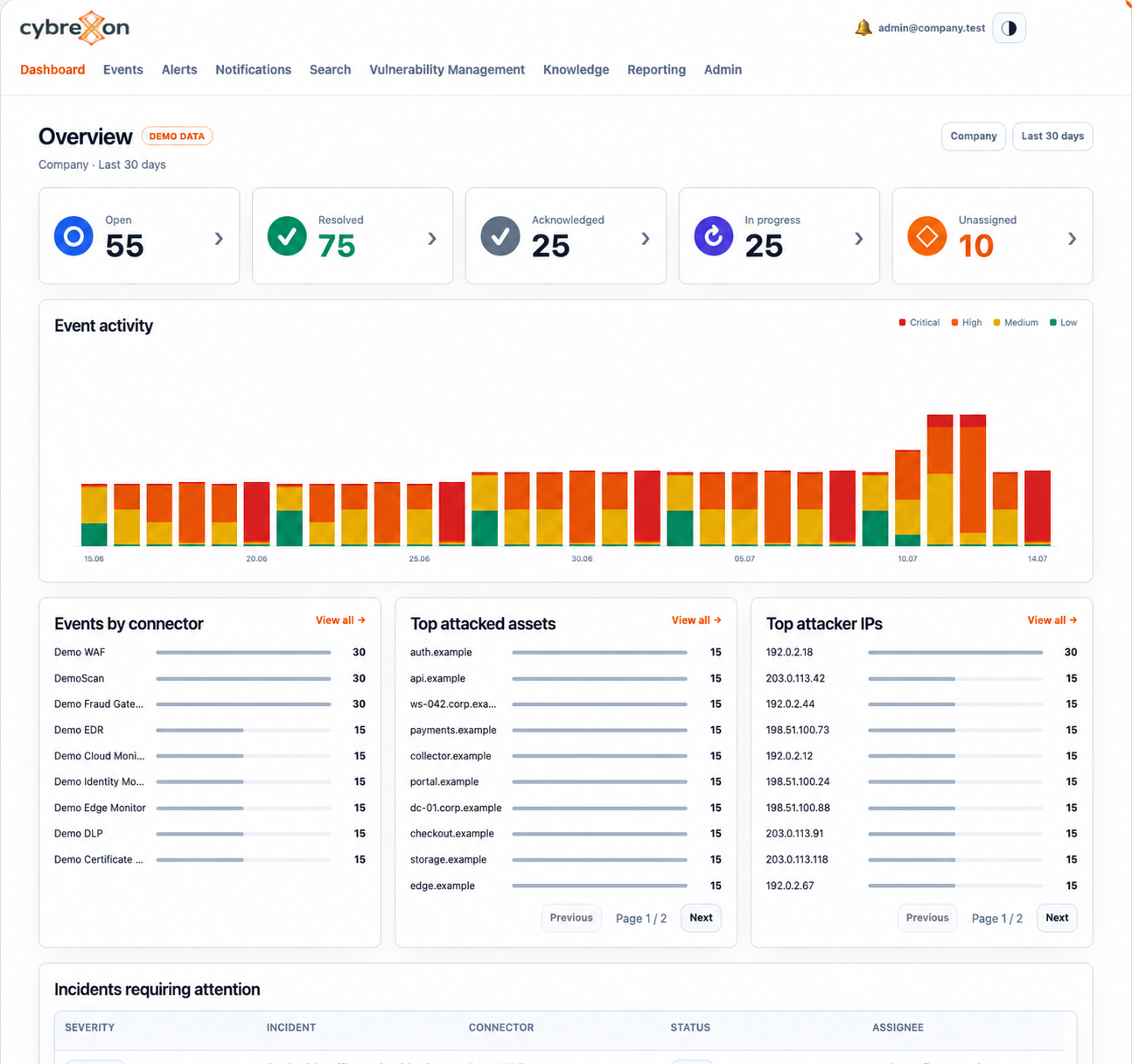
IRP connects the day-to-day work around incidents: intake, review, ownership, collaboration, guidance, resolution, and reporting.
Connect systems with different JSON structures and bring their fields into a consistent format without developing separate rules for every source.
An administrator links fields from incoming JSON to IRP fields in a visual editor, immediately sees the result, and configures a new source without changing code.
Channel settings, templates, and routing rules determine which event notifications are sent and to whom.
Knowledge categories can be linked to connectors. From an incident, analysts can immediately open the relevant instruction, diagram, article, or procedure.
Status, priority, owner, comments, materials, source data, and decisions stay together from Open to Resolved.
Every source has its own connector, including security tools, applications, infrastructure, and services.
Generate a separate report from stored event details and investigation materials for any period and selected events.
Administrators manage users and access, while team members see only the connectors, incidents, and working materials they need.
Every vulnerability scan is stored as one normalized incident with all hosts, ports, and identified issues, regardless of the result size.
Administrative and operational actions in IRP are recorded for investigations, accountability, and compliance reviews.
View events by status, priority, category, connector, affected asset, source address, and vulnerability details.
Different filters let you select events by operational fields, priorities, owners, or statuses.
Roles and connector permissions restrict operational information according to each team member's responsibilities.
Open, Acknowledged, In progress, and Resolved show exactly which stage the incident work has reached while preserving the full history of changes.
IRP records the actual time between acknowledgment and resolution and includes it in the incident and its report.
Assignments, replies, and mentions reach the right person through personal notifications, while the entire discussion remains inside the incident.
The service integrates easily with existing infrastructure and security tools. We collect the event stream, while our SIEM system uses unique rules to detect malicious activity. Real incidents are identified immediately and sent to IRP for analysis and escalation.
Security tools, applications, infrastructure, and cloud services send their events into IRP through separate, controlled connections.
IRP retains the submitted JSON so analysts and administrators can verify mapped values against the source record.
Fields from different sources are mapped to a consistent event model. The source data remains available for verification.
Events that require attention are recorded with severity, status, category, source, affected asset, and responsible person.
Analysts verify the available data, determine priority, assign responsibility, and record their decisions.
Configured rules can send event notifications through Telegram, Slack, and email when specified conditions are met.
Comments, evidence, assignments, and status changes remain associated with the investigation, while relevant actions are audited.
Generate a report from stored event details and investigation materials for responsible staff, technical review, or management.
Cybrexon AntiFraud detects and investigates suspicious activity using device, session, behavior, transaction, and API data. The results are recorded in Cybrexon IRP for analyst review and further work.
Device, browser, network, and session attributes help analysts identify reused environments, automation, and unusual access combinations.
User and transaction activity can be assessed for unusual sequences, frequency, amounts, API use, and changes in normal behavior.
Suspicious authentication, changes in environment, and abnormal session combinations can be connected with the account and investigation history.
Technical data and information about operations help identify automated abuse and suspicious API requests before individual signals are lost in application logs.
Rules and accumulated context help prioritize suspicious activity and direct it to an analyst with the information needed for a decision.
AntiFraud signals become incident records with assigned responsibility, evidence, decisions, notifications, and reports.
Cybrexon provides security event monitoring, vulnerability management, AntiFraud, security consulting, and assistance during incidents. Cybrexon IRP connects these services in one system, providing continuous event visibility and control over the work performed for every incident.
Brings events, incidents, owners, decisions, and response time together in one system.
Analysts review security events, determine priorities, assign responsibility, record decisions, and prepare reports.
Vulnerability scan results and signs of fraud are reviewed, prioritized, and linked to affected assets and incidents.
We assess security, analyze risks and architecture, help prepare procedures, and provide support during active incidents.